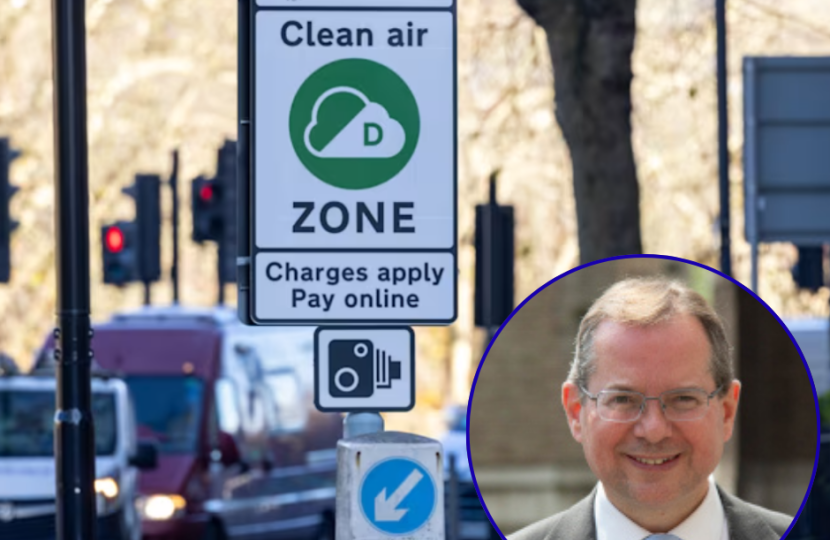
Conservative Councillor Jonathan Hucker is calling on Bristol City Council to provide clearer and more comprehensive information on how income generated by the city’s Clean Air Zone (CAZ) is being spent.
The controversial scheme started in November 2022 and was a direct result of Government intervention instructing the Authority to meet legal limits on nitrogen dioxide (NO2) emission targets.
Although the annual income raised through charges and fines is not published, one figure often quoted stated that it raised £31.2m in its first full year of operation. National regulations stipulate any surplus in these receipts can only be spent on things that:-
- Directly improve air quality, such as reducing harmful pollutants from transport.
- Indirectly support cleaner air, including investment in the wider transport network, for example through new or improved bus services.
- Tackle congestion, where this contributes to improved air quality.
- Cover the cost of operating, enforcing, and improving the CAZ scheme itself.
However, the definition of such transport-improvement measures appears to be quite broad and flexible. For example, at the last budget-fixing meeting, one amendment proposed using this revenue to improve road-signage, something that would normally be deemed a standard maintenance cost.
Now, Cllr Hucker has tabled a motion, together with Member Forum questions, at the next Full Council (10th March 2026), that asks for greater transparency on how and where this money is expended to ensure that these funds are being properly applied.
Cllr Hucker (Stockwood) said: “The rules around CAZ income clearly stipulate this must not be used simply to bolster budgets.
“The Authority will already be required to report to DEFRA/DfT and the Joint Air Quality Unit (JAQU) on how this revenue is being used.
“I believe the public – especially those who are actually generating this money – have a right to know how it is being spent. An itemised list of expenditure/projects should be published.
“In this way, residents will be able to discern where CAZ proceeds go and judge for themselves whether the scheme is being run fairly and in line with its stated purpose.
“One final point also needs to be made here. When the city eventually maintains the necessary reduction in harmful emissions ‘in the shortest possible time’, I fear its success will then be used by a future Administration as a justification for a successor revenue raising model, congestion charging. My Group remains implacably against any such move.
“In recent years, we have seen that politicians would much rather raise taxes than find ways to reduce public spending.”
COUNCILLOR JONATHAN HUCKER: 07584186522
Note to Editor: please find below a copy of the Conservative motion
TRANSPARENCY ON USE OF CAZ INCOME
“This Council believes that greater clarification needs to be provided on the permissible use of Clean Air Zone funding which is designed to contribute towards the city achieving legal air-quality compliance.
National regulations provide very broad guidelines on the types of action which can be paid for out of CAZ income. These are things that can be said to directly improve air quality by reducing harmful pollutants, and those measures which have an indirect impact on this problem by investing in the wider transport network such as through funding new bus services.
The rules also allow for these penalty charges to be put to use in tackling congestion or towards the cost of running, enforcing and improving the CAZ scheme itself. Whilst this revenue is explicitly not meant to simply bolster budgets, Council is concerned that the concept of transport-related projects remains ill-defined, elastic, and elusive.
Accordingly, in the interests of ensuring consistency and transparency in the application of CAZ receipts, Council calls on the Chairman of the Transport & Connectivity Committee to set officers the task of producing and publishing comprehensive data itemising all CAZ-funded projects – not just financial support schemes which already takes place.
In this way, residents will be able to clearly see where CAZ proceeds go and judge for themselves whether or not the scheme is being run fairly and in line with its stated purpose.”